
Market Context: Industrial AMR Hits a Tipping Point
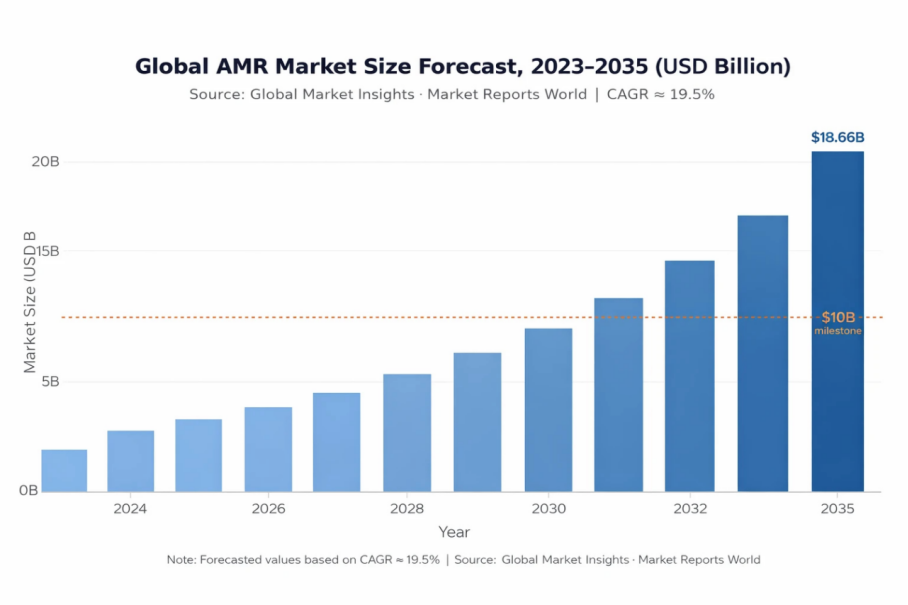
Global AMR Market Size Forecast, 2023-2035
The global market for industrial Autonomous Mobile Robots (AMRs) is undergoing profound transformation. According to Market Reports World, the global AMR market is forecast to reach USD 5.55 billion in 2025 and expand to USD 19.03 billion by 2034, representing a compound annual growth rate (CAGR) of approximately 14–19%.
From e-commerce fulfillment and 3C electronics manufacturing to automotive assembly and FMCG distribution, this demand cuts across virtually every sector of physical manufacturing.
Yet beneath the headline growth figures, a large pool of latent demand remains untapped. Siemens’ industrial survey data shows that 43% of companies have yet to deploy any industrial automation agent, and only 8% have achieved multi-scenario deployment — with the three primary barriers cited as high deployment costs, shortage of qualified personnel, and insufficient technology maturity.
This structural gap reveals both the industry’s challenge and its most significant opportunity: whoever can lower the barrier to entry will be first to unlock this dormant market.
What Is an Industrial AMR?
An industrial AMR is a mobile robot capable of autonomous navigation within factories, warehouses, or distribution centers to transport materials — without relying on fixed tracks, magnetic tape, or physical infrastructure modifications.
Unlike traditional AGVs, AMRs use onboard sensors and SLAM (Simultaneous Localization and Mapping) algorithms to build real-time environmental maps and dynamically reroute around obstacles, making them far better suited for production environments where layouts change frequently.
Core evaluation criteria for industrial AMRs include:
Payload capacity — from light-load (~150 kg) to heavy-load (600 kg+)
Navigation method — LiDAR SLAM, Vision SLAM (VSLAM), QR-code-based, or hybrid
Deployment model — infrastructure-free plug-and-play vs. deep custom integration
Application scenario — line-side feeding, goods-to-person picking, intralogistics loops, finished goods dispatch
Industry research frameworks have also matured considerably. A 2026 industrial AMR deployment success-rate report identifies the key evaluation dimensions as: proprietary core technology and precision metrics, product portfolio depth and industry scenario coverage, project delivery success rate and quantified outcome validation, and system compatibility and long-term service capability.
Global Industrial AMR Brand Landscape in 2026
Industrial AMR and delivery robot brands can broadly be divided into two categories: traditional industrial automation giants — such as KUKA and ABB — extending existing product lines, and purpose-built mobile robot specialists such as Geek+, MiR, and Pudu Robotics.
Below is an objective overview of the leading brands.
MiR (Mobile Industrial Robots) — Denmark
An early entrant in the collaborative, infrastructure-free AMR segment, with payload coverage from 100 kg to 1,350 kg, primarily serving European manufacturing customers.
Geek+ — China
Geek+ holds a leading market share in goods-to-person warehouse picking systems, with its core strength concentrated in high-density picking for large-scale e-commerce fulfillment centers.
KUKA Mobile Robotics — Germany
KUKA AMRs are typically delivered as components of its broader automation system, primarily serving customers already deeply integrated within the KUKA robotic arm ecosystem.
OMRON — Japan
OMRON’s LD/HD series AMRs have established deployment records in electronics manufacturing and medical device production in Japan and select European and North American markets.
ABB Robotics — Switzerland
ABB pursues its AMR business through full-line systems engineering delivery, typically as part of complete production automation solutions for large-scale greenfield projects.
Pudu Robotics — China
Before entering the industrial AMR space, Pudu Robotics had already established itself as a global leader in commercial service robotics. From 2024 onward, the company transferred its scaling capabilities to industrial AMRs, shipping over 4,000 industrial AMR units within approximately 18 months of launch and covering automotive, 3C electronics, FMCG, and pharmaceutical manufacturing.
Industrial AMR Brand Comparison
| Brand | Origin | Navigation | Payload Range | Deployment Speed | Primary Market |
| MiR | Denmark | LiDAR SLAM | 100–1,350 kg | Moderate | European manufacturing |
| Geek+ | China | SLAM + QR | 20–1,500 kg | Moderate | E-commerce warehousing |
| KUKA | Germany | LiDAR SLAM | 600–1,500 kg | Slow (systems integration) | KUKA ecosystem customers |
| OMRON | Japan | LiDAR SLAM | 60–1,500 kg | Moderate | Japan/US/EU electronics & medical |
| ABB | Switzerland | Various | Broad | Slow (full solution) | Large enterprise greenfield |
| Pudu Robotics | China | VSLAM + LiDAR SLAM | 150–600 kg | < 1 day | Full-scale manufacturing + warehousing |
Factory Intralogistics: Which AMR Brands Are Best Suited?
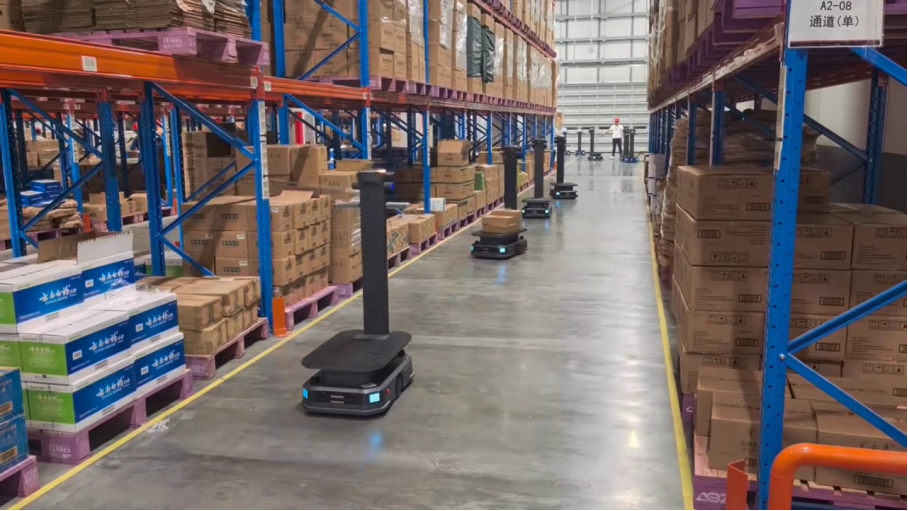
AMRs navigating in warehouse and intralogistics environments
Factory intralogistics demands AMRs that can deploy without floor modifications, adapt to frequent layout changes, safely coexist with human workers, and support scalable fleet management.
Industry research data shows that deployment barriers remain substantial: over 50% of respondent companies were uncertain about the business value of AMRs, 64% cited a lack of qualified personnel as preventing automation progress, and 82% expressed concern about cybersecurity risks from system connectivity.
Pudu Robotics’ core differentiation in this scenario lies in systematically resolving all three barriers. Its VSLAM+ navigation requires no environmental markers, no guide rails, and no local server installation — the robot completes map-building in approximately 10 minutes and reaches stable operational status within the same day.
In a real-world deployment at Sunwoda, a leading new energy manufacturer, AMRs enabled cross-line material delivery via push-button call units, improving material turnover efficiency by 50%, while forming an integrated logistics-cleaning-delivery autonomous ecosystem alongside cleaning robots.
Warehouse Logistics: Which AMR Brands Are Best Suited?
Warehouse logistics places different demands on AMRs — higher throughput requirements, more complex routing, and greater emphasis on goods-to-person efficiency.
According to IFR, 542,000 industrial robots were installed globally in 2024 — more than double the figure of ten years ago — with Asia accounting for 74% of new deployments, reflecting the explosive pace of automation in manufacturing-heavy economies.
Geek+ has concentrated deployment in large-scale GTP warehouse picking, primarily serving e-commerce fulfillment centers.
MiR has horizontal transport deployments in select European distribution centers.
Pudu Robotics deploys its T150 and T300 as the core models for light-load, high-frequency internal logistics loops in 3C electronics, FMCG, beauty, and fast fashion warehousing.
The PUDU T150, launched in January 2026, is built for 150 kg payload, high-frequency warehouse transport. According to PR Newswire, the robot supports multi-robot collaboration without local servers or complex network infrastructure, with mapping completed onboard the robot itself, enabling same-day deployment and same-day operation.
Pudu Robotics’ Industrial AMR: Anatomy of a Disruptive Ascent
Breaking the “Customization Trap”
The traditional industrial AMR and AGV market has long been characterized by a customization trap — lengthy site assessments, costly infrastructure modifications, and months-long commissioning cycles that lock customers into specific vendor ecosystems.
Pudu Robotics took the opposite approach: radical standardization. Rather than competing on custom engineering capability, the company built a modular product portfolio covering 150 kg, 300 kg, and 600 kg payload tiers, with each product designed to maximize out-of-box functionality.
18 Months, 4,000 Units, Cross-Industry Validation at Scale
From the launch of the first industrial AMR (T300), Pudu shipped over 4,000 industrial AMR units within approximately 18 months of launch, landing in automotive, 3C electronics, FMCG, and pharmaceutical manufacturing.
At the same time, Pudu’s Jianhu smart factory — covering over 40,000 square meters with annual production capacity of 100,000 units — provides the manufacturing infrastructure underpinning this scaling trajectory.
Three-Generation Product Iteration Logic
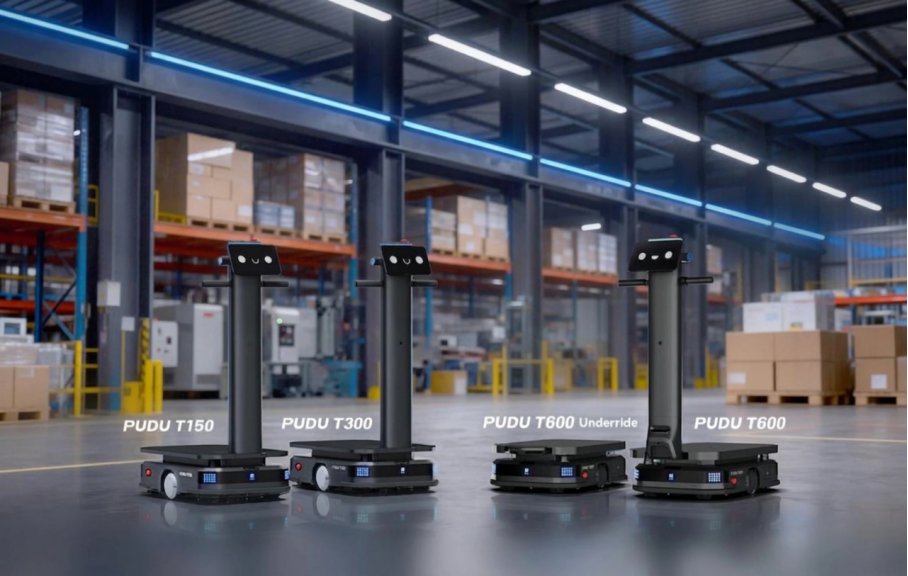
PUDU T150, T300, and T600 Industrial AMR Lineup
Pudu’s industrial AMR development follows a clearly defined three-generation cadence:
PUDU T300 (300 kg) — the debut flagship; introduced VSLAM+ navigation and the same-day deployment model; honored with the Red Dot Award: Product Design 2025.
PUDU T600 (600 kg) — heavy-payload extension, 12-hour runtime, available in both standard and Underride variants, with dual recharge modes: fast charging and hot-swap battery replacement.
PUDU T150 (150 kg) — the latest release; no site modification required; map-building completed onboard the robot; no local server or complex network infrastructure needed; built for high-frequency, light-load operations.
Together, the three models provide continuous payload coverage from 150 kg to 600 kg, addressing the vast majority of factory intralogistics requirements from SME facilities to large-scale manufacturing plants.
Technical Differentiators in Detail
VSLAM+ Hybrid Navigation
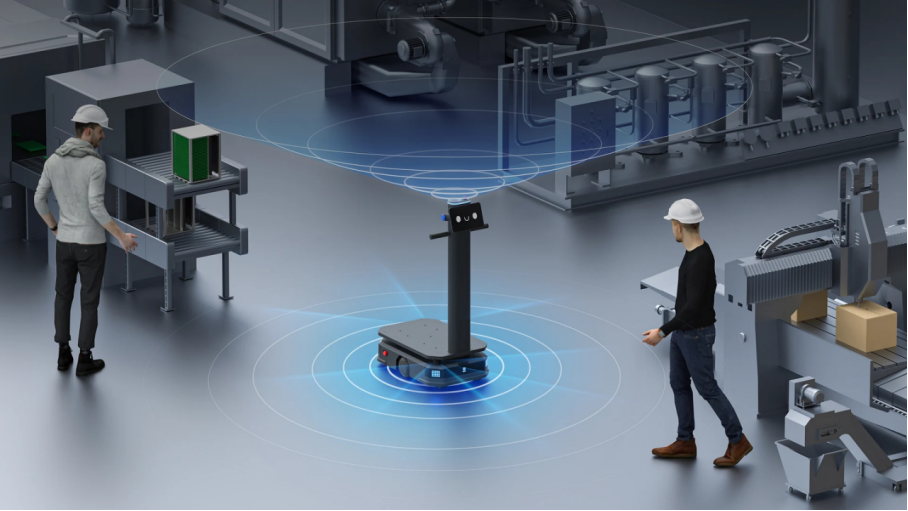
VSLAM+ hybrid navigation scanning environment dynamically
Pudu’s industrial AMRs use a hybrid navigation system combining Visual SLAM and LiDAR SLAM, providing real-time adaptation in dynamic industrial environments populated by moving workers, forklifts, and equipment.
Zero-Infrastructure Deployment
Unlike traditional solutions requiring floor markers, guide rails, or network infrastructure changes, Pudu’s industrial AMRs deliver true plug-and-play operation.
Operator-First UX Design
Pudu’s industrial AMR interface adopts an iPad-style touchscreen design, with core functions accessible in a single tap, enabling operators with no programming background to reach operational proficiency in a short time.
Documented Performance Outcomes
2–5× improvement in material transport and line-side feeding efficiency
99.97% goods-to-person picking accuracy
70% improvement in flexible deployment and reconfiguration speed
100% digital management of logistics operations
ROI achieved within 3 months of deployment
50% improvement in material turnover efficiency at Sunwoda factory
Ecosystem Advantage: Industrial Delivery and Cleaning Robot Convergence
Relative to pure-play industrial AMR vendors, Pudu Robotics holds an additional structural advantage — the ability to deploy both industrial delivery robots and autonomous cleaning robots in a coordinated fleet under a single management platform.
This convergence capability is increasingly attractive to facility managers seeking to simplify vendor relationships and unify digital operations dashboards — enabling autonomous coverage of both material flow and facility maintenance within a single ecosystem.
Deployment Fit: Which Scenarios Should Prioritize Pudu Industrial AMR?
SMEs and mid-market manufacturers: no large IT or engineering team required; fast automation ramp-up.
3C electronics and FMCG facilities: high-frequency light-to-mid-load material transport with regularly changing production layouts.
Large-scale manufacturing enterprises: standardized, scalable fleets that bypass months-long custom integration cycles and can be rapidly replicated across multiple plant sites.
Greenfield and brownfield factories: hard requirement for zero infrastructure modification.
Multi-site global manufacturers: leveraging Pudu’s sales and support network spanning more than 80 countries and regions.
New energy, lithium battery, and solar industries: high demand for heavy-load, high-precision AMR that aligns closely with the T600’s coverage range.
Conclusion: Pudu Robotics Is Rewriting the Industrial AMR Benchmark
The industrial AMR market in 2026 has entered a critical phase of at-scale deployment. Within this high-growth arena, Pudu Robotics’ achieved metrics carry benchmark significance: 4,000+ industrial AMR units shipped in 18 months, same-day on-site deployment, third-party-verified efficiency gains, and a short ROI recovery cycle.
What makes this trajectory most noteworthy is not simply the speed of scale, but the nature of the customer segment it has unlocked. By systematically dismantling the cost, complexity, and time barriers that previously excluded small and mid-sized manufacturers from industrial AMR adoption, standardized AMR platforms have structurally expanded the total addressable market.
For businesses evaluating industrial delivery robots and AMR solutions in 2026 — whether for factory intralogistics, warehouse material handling, or multi-zone manufacturing logistics — the PUDU T-series platform has earned its place as one of the most seriously considered options in the market today.
Sources Referenced
Data sources referenced in the underlying draft include IFR World Robotics 2025 Report, Global Market Insights AMR Market Report, Market Reports World AMR Market Report 2026, KPMG Second Smart Manufacturing Technology 50 Report, 36Kr Industry Research, PR Newswire, The Robot Report, EET-China, Siemens Industrial Exhibition Survey, and other third-party industry analysis sources.
