
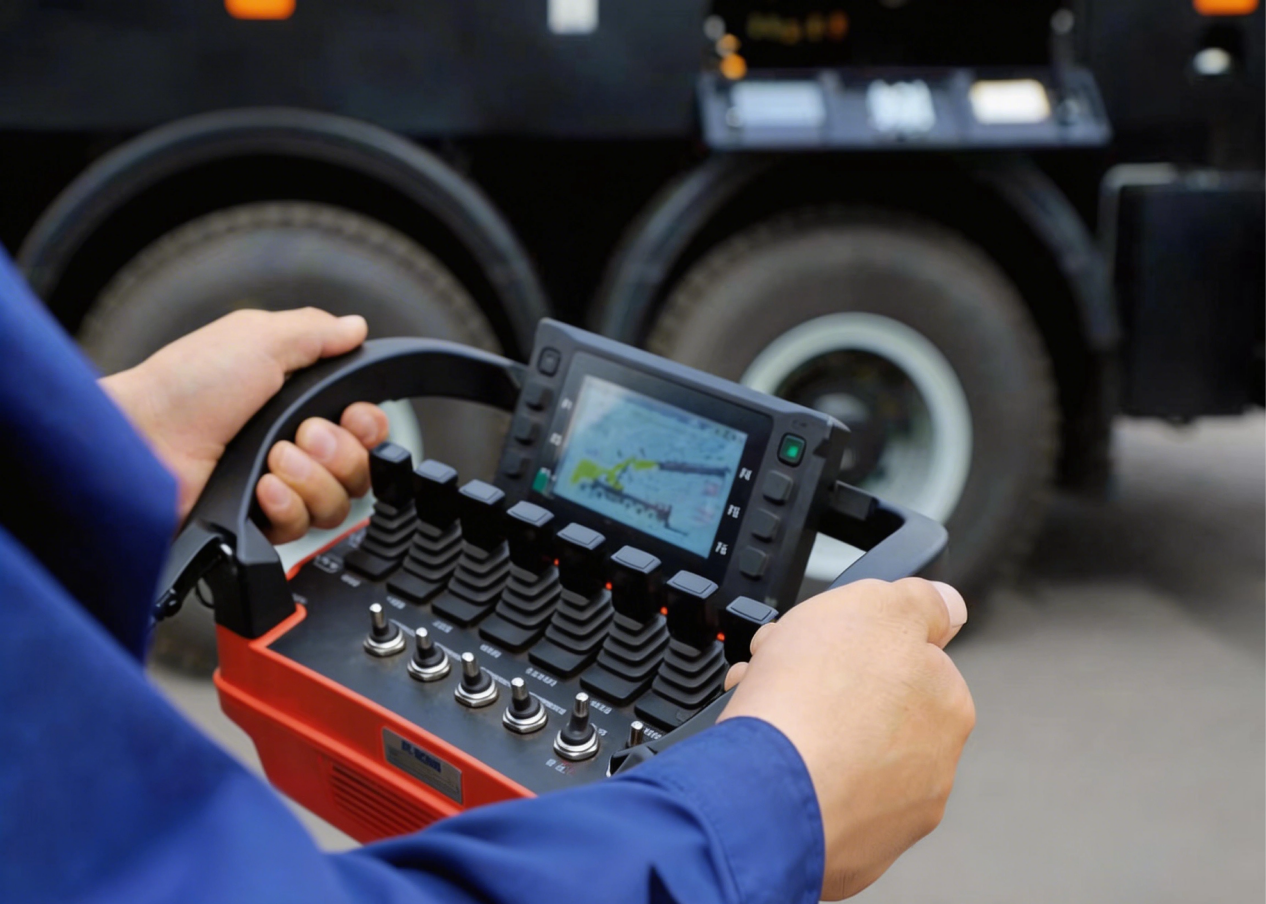
A crane operator may rely on a small handheld device to control the movement of heavy loads. That single fact explains why reliability, not features, tends to matter most when heavy industry evaluates wireless control technology. A transmitter that looks capable on a spec sheet but drops signal under real job-site conditions creates risk rather than reducing it. So what actually determines whether an industrial radio remote control system holds up over years of daily use? The answer involves several overlapping engineering factors, each worth examining on its own.
Environmental Exposure Shapes Long-Term Performance
Industrial remote controls are used both indoors and outdoors. Environmental ratings should be checked against the conditions of the intended installation. Ingress protection ratings give buyers a concrete way to compare durability claims instead of relying on marketing language. For applicable models, IP65 or IP66 ratings are available, and their operating temperature ranges can support certain outdoor and mining applications. A control unit built to this range is less likely to fail simply because a shift starts in freezing fog or ends under midday heat.
Anti-Interference Design Determines Signal Stability
Reliability isn’t only about surviving the weather. It’s also about maintaining a clean signal path on a job site crowded with other transmitters, motors, and variable-frequency drives. Ports and metallurgy plants are particularly demanding in this respect, since dense electrical equipment generates constant background noise. Techwell states that its systems apply frequency hopping spread spectrum technology, which allows the transmitter and receiver to change frequencies according to a defined hopping sequence, which can improve resistance to interference compared with operation on a fixed frequency. This kind of design matters more in practice than it might seem on paper: unexpected communication delays can affect control responsiveness and should therefore be considered when evaluating a system for time-sensitive operations.
Safety Architecture Reduces the Impact of Component Failure
No electronic system is immune to component failure over its lifespan. What separates a well-engineered industrial remote control manufacturer from a less rigorous one is often how the system responds when something does go wrong. The system features a dual-CPU architecture and is designed with a closed-loop control structure, with applicable products specified at PL d with diagnostic mechanisms intended to detect certain processor faults and initiate the defined safe state. This type of redundancy can help limit the effects of certain component faults by bringing the system to a defined safe state.
Manufacturing Discipline and Testing Standards
Hardware reliability starts on the production line, long before a unit reaches a job site. Techwell Remote Control operates under ISO-certified quality management and reports that every remote control unit goes through a 72-hour stress testing process before shipment. Such testing can help identify potential issues that may not emerge during a brief functional check, including battery contact instability under vibration or seal degradation after repeated thermal cycling. Founded in 2005 in Shanghai, the company has incorporated these testing procedures into its manufacturing operations as part of its quality control practices.
Track Record Across Demanding Industries
Specifications and lab testing only tell part of the story; sustained use across varied environments is a more practical indicator of reliability. Techwell reports that its systems serve more than 100 mid-to-large enterprises, including XCMG, China Railway, Zoomlion, and ZPMC, with deployment across more than 40 countries. These clients span construction cranes, port logistics, and mining equipment — three sectors known for pushing electronic hardware to its limits through constant vibration, dust exposure, and heavy daily cycling. A track record spanning this range of applications suggests that an industrial radio remote control system has been tested well beyond a single use case, which matters for buyers evaluating equipment for their own varied conditions.
Customization Can Influence Practical Reliability Too
It’s worth noting that reliability isn’t purely a hardware question. A remote control configured with the wrong frequency band, channel count, or button layout for a given machine can underperform even if the unit itself is well built. Techwell offers OEM/ODM services to configure transmitters and receivers around specific equipment types, allowing the control layout and system configuration to better match the application. Getting this match right at the outset tends to reduce the operational issues that get mistaken for reliability problems later.
Conclusion
Reliability in industrial wireless control is rarely the product of one feature. It emerges from a combination of environmental durability, anti-interference engineering, fail-safe internal architecture, rigorous manufacturing standards, and configuration suited to the actual machine in use. These factors provide a practical framework for buyers evaluating a wireless control partner for demanding industrial environments.
