
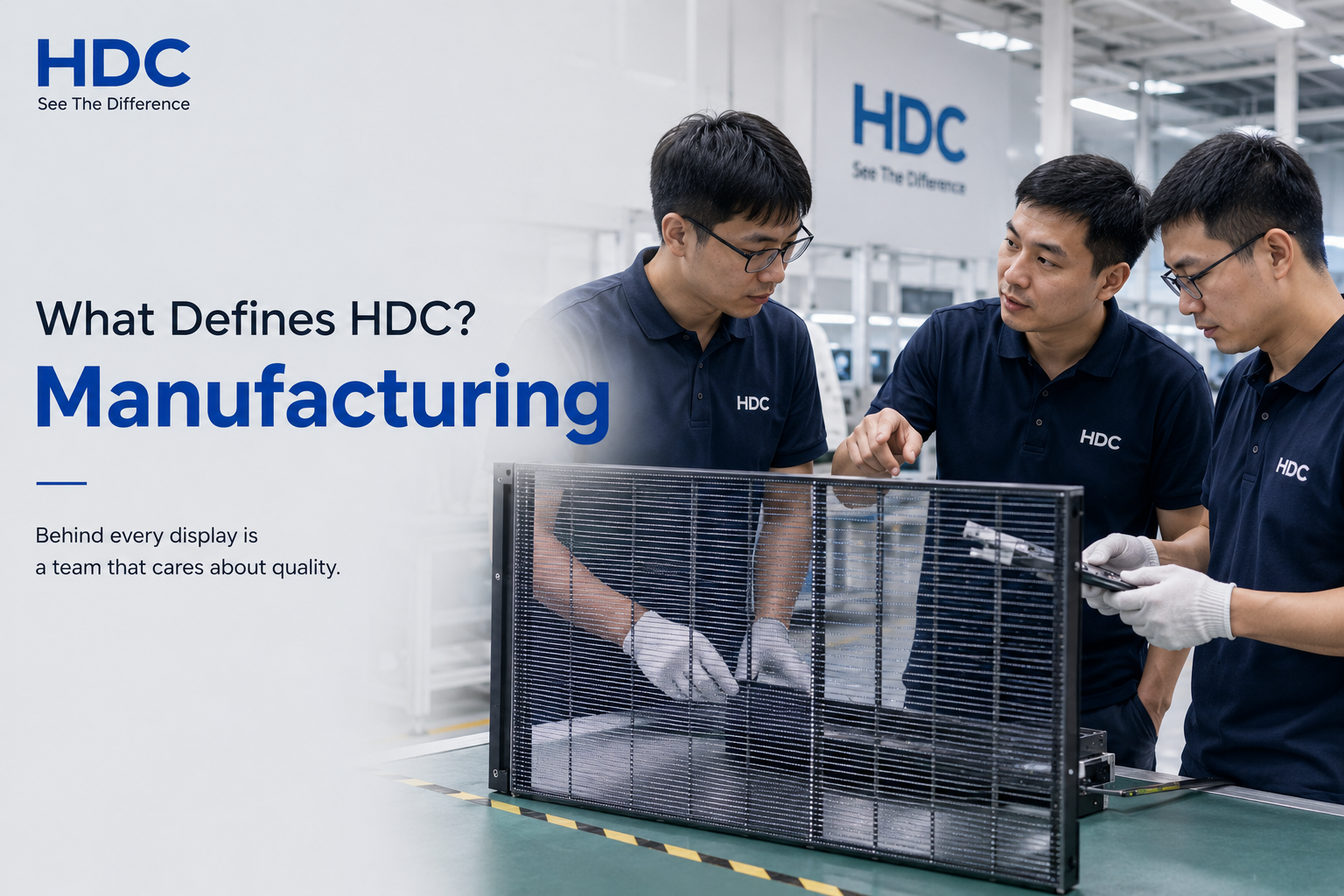
A distributor choosing an LED screen manufacturer is making a supply-chain decision as much as a product decision. The finished cabinet matters, but reliable distribution also depends on whether the supplier can translate project requirements into repeatable configurations, control production, verify performance, support customization, and respond after shipment.
A broad catalog without engineering depth can create problems when a customer needs a nonstandard design or technical explanation. Conversely, manufacturing capacity has limited value if quality control is unclear or project support ends once the goods leave the factory.
A useful evaluation therefore follows the product through its full path: development, component inspection, assembly, calibration, testing, delivery, installation, and technical service.
Look for Control of Product Development and Manufacturing
Evidence of supplier capability should extend beyond final assembly. Distributors benefit from understanding where product decisions are made, how customer requirements reach engineering, and whether manufacturing feedback can return to the design team.
HDC has operated since 2004 and integrates R&D, manufacturing, and sales of LED displays. It also maintains production bases in Jiangsu and Anhui. Those facts are relevant because integrated functions can be examined as one process rather than as disconnected vendors.
The evaluation should still focus on evidence: how specifications are translated into production instructions, how changes are communicated, and whether the manufacturer can explain why a configuration suits a particular project.
A distributor serving different markets may encounter indoor, outdoor, rental, transparent, or other display requirements, so the supplier’s ability to connect engineering choices with application conditions is more useful than simply presenting many models.
Test the Quality System Through Specific Production Steps
Quality claims become meaningful when they can be tied to observable controls. For an LED screen, distributors can ask how incoming components are inspected, how modules are tested, how brightness is calibrated, how aging tests are performed, and how color consistency is checked before shipment.
HDC’s quality control runs from component inspection through final performance verification and includes module testing, brightness calibration, aging tests, and color-consistency checks.
This creates a practical audit path. Instead of asking whether quality is “strict,” a distributor can ask what is measured at each stage, what happens when a result falls outside the required range, and how the final display is verified before release.
Such questions also reveal whether quality is treated as a separate final inspection or as a sequence of controls throughout production. Repeatability is particularly important for distributors because later orders should not depend on informal adjustments that cannot be reproduced.
Check Whether Customization Is an Engineering Capability
OEM/ODM work should be evaluated as a development process, not merely as permission to change a logo or packaging. A distributor may need cabinet formats, product configurations, or other project-specific adaptations that fit its market and brand requirements.
HDC describes its OEM/ODM services as covering custom design, flexible manufacturing, quality assurance, and global logistics, with an R&D team developing configurations around project and brand needs.
That scope gives distributors several points to examine: how custom requirements are documented, which changes require engineering review, how prototypes or configurations are verified, and how the approved result is transferred into production.
A capable LED screen manufacturer should be able to explain the boundary between a standard product option and a genuine engineering change. Clear boundaries reduce the risk that sales expectations exceed what manufacturing and testing can consistently deliver.
Evaluate Technical Support Beyond the Factory Gate
Distribution continues after production. Installation questions, configuration issues, customer-specific design decisions, and later technical service can affect the distributor’s own reputation. HDC reports engineering support for design, customization, installation, and technical service, and its project experience extends to more than 50 countries.
These details are useful because they broaden the evaluation from factory output to project execution. A distributor can examine how technical questions are routed, what information is available during installation, and whether the same supplier can support a project when a configuration departs from a standard order.
International experience is not a substitute for checking the needs of a particular market, but it can indicate exposure to varied project conditions and logistics. The practical question is whether support responsibilities are clear enough that the distributor knows what can be handled by the manufacturer and what must be managed locally.
The strongest manufacturer assessment combines these areas rather than scoring them separately. HDC offers an example of an integrated structure that includes R&D, manufacturing, OEM/ODM activity, documented production checks, international project experience, and engineering support.
Distributors should still verify how those capabilities apply to the specific products and markets they intend to serve, including who owns technical decisions, how changes are documented, and what support remains available after delivery.
An LED screen partnership is easier to manage when product development, quality evidence, customization, logistics, installation assistance, and after-sales technical support form a traceable chain. That approach replaces general impressions with questions that can be answered by processes, records, specifications, and clearly defined responsibilities.
