
Ammonia (NH₃) is widely used across industrial operations, including fertilizer production, chemical manufacturing, petroleum refining, food processing, and refrigeration. Its industrial value comes with a significant safety challenge: ammonia can irritate or severely damage the eyes, skin, throat, and respiratory system at elevated concentrations.
Unlike hazards that remain confined to a specific piece of equipment, ammonia can spread through a workplace following a leak, release, or equipment failure. Effective safety therefore requires more than routine inspections. Facilities need a detection strategy that considers where ammonia may escape, how workers interact with those areas, and how quickly conditions can change.
Why Ammonia Requires Continuous Attention
Ammonia is a colorless gas with a pungent, suffocating odor. It is also lighter than air, with an OSHA-listed vapor density of 0.6 compared with air. Its physical characteristics influence how it moves after a release and should be considered when planning monitoring and ventilation systems.
Exposure severity depends on concentration, duration, and the nature of the work being performed. NIOSH notes that high concentrations can irritate or burn the skin, mouth, throat, lungs, and eyes, while very high exposure can cause severe lung injury or death.
Anhydrous ammonia presents an additional concern because it is commonly stored under pressure. OSHA states that even relatively small releases can threaten employee health and safety, while its published data lists an immediately dangerous to life or health concentration of 300 ppm.
Identify Where Ammonia Exposure Can Occur
A useful detection strategy begins with a site-specific hazard assessment. Refrigeration machinery, storage vessels, transfer lines, valves, pumps, compressors, and connection points can all become potential release locations depending on the industrial process.
Food processing and cold-storage facilities deserve particular attention because ammonia can be used as a refrigerant. Agricultural and chemical operations may also encounter ammonia during fertilizer production, handling, or related processes. Petroleum, metallurgy, rubber, and other industries can present additional exposure scenarios.
Maintenance activities can change the risk profile considerably. Opening equipment, replacing seals, servicing valves, disconnecting lines, or entering areas around ammonia-containing systems may create exposure opportunities that do not exist during normal operation. Monitoring should therefore reflect both routine production and non-routine tasks.
Use a Gas Detector Where Workers Need Protection
A Gas Detector provides an additional layer of awareness by identifying atmospheric conditions that cannot be judged reliably through visual inspection alone. For mobile workers, portable detection can be especially useful because the monitoring point moves with the person instead of remaining fixed to one location.
The right instrument depends on the identified hazard. Where ammonia is the primary concern, a single-gas configuration may be appropriate. Where several atmospheric hazards can occur simultaneously, a multi-gas instrument can allow operators to monitor multiple gases with one portable device.
Sampling method is another important consideration. Diffusion-based instruments can monitor the atmosphere surrounding the worker, while pumped systems can draw samples from locations that are difficult or unsafe to approach directly. The selection should reflect the facility layout, task requirements, and risk assessment.
Match Detection to the Work Environment
Portable monitoring is particularly useful for inspection rounds, maintenance, equipment checks, and other activities in which employees move between different areas. It can also supplement fixed monitoring around known release points, creating different layers of protection across a facility.
For example, a refrigeration plant may use permanently installed detection around critical equipment while maintenance personnel carry portable instruments during service work. This approach addresses two different questions: whether a particular area remains under surveillance and whether the worker’s immediate environment is changing.
Equipment specifications should also be reviewed carefully before procurement. Important factors can include the gases detected, sensor type, response time, alarm methods, operating temperature, battery endurance, protection rating, and explosion-proof certification. These characteristics should be evaluated against actual workplace conditions rather than selected solely by price.
Consider Pumped Sampling for Difficult Locations
Some ammonia hazards may occur around enclosed equipment, ducts, vessels, or other areas that are difficult to access directly. In such applications, pumped sampling can provide a practical way to draw air toward the sensor while allowing the operator to remain at a safer position.
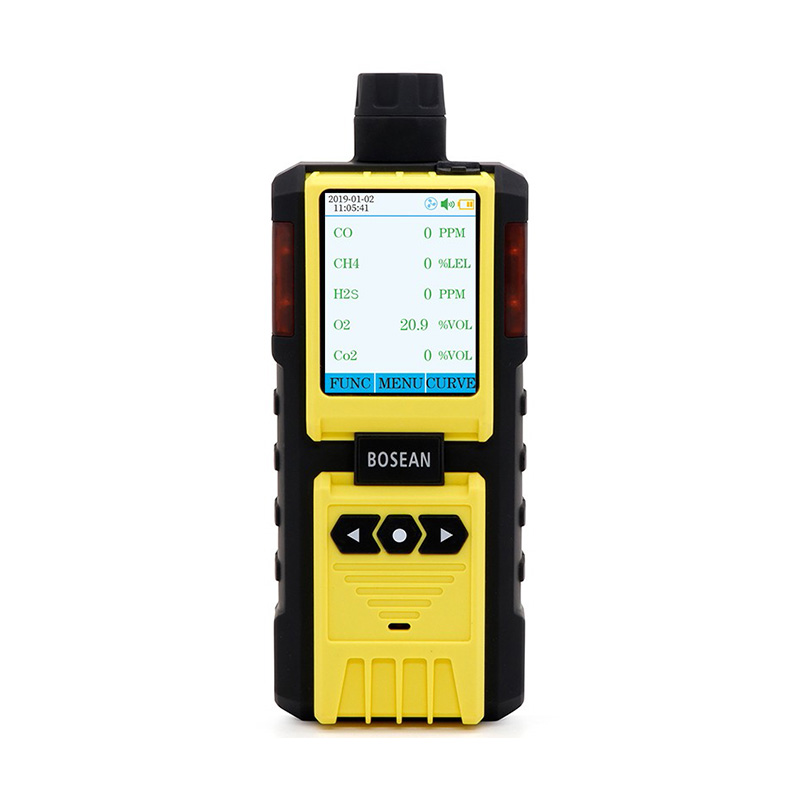
The K-600 5 in 1 Multi Gas Detector from Bosean is one example of a portable instrument that uses gas pump sampling. Its official specifications list an accuracy of no more than ±5% F.S. and a response time of no more than 30 seconds. The manufacturer states that ammonia and other gases such as NO, PH₃, NO₂, HCN, and SO₂ can be specified in advance.
The K-600 has an operating environment of -20°C to 50°C and less than 95% relative humidity without condensation. It uses a 3.7 V, 3200 mAh lithium-ion battery and is specified for at least eight hours of continuous operation without alarming. Its listed protection grade is IP65, explosion-proof grade is Ex ib IIC T4 Gb, and weight is approximately 400 g including the battery.
These specifications demonstrate why industrial buyers should define their application before selecting a detector. A device intended for ammonia monitoring should be configured for the required gas and assessed for sampling needs, environmental conditions, mobility, and certification requirements.
Combine Detection With Process Controls
A Gas Detector should support, rather than replace, broader safety measures. NIOSH recommends applying the hierarchy of controls when managing ammonia exposure, which means organizations should first consider eliminating or reducing hazards through engineering and process controls before relying on personal protective measures.
Ventilation, equipment maintenance, leak prevention, isolation procedures, employee training, and emergency planning can all contribute to risk reduction. Detection adds another layer by helping personnel recognize changing atmospheric conditions and respond according to established procedures.
Alarm settings also deserve careful attention. Facilities should establish response actions appropriate to their risk assessment and applicable regulations. Workers should know what different alarms mean, when to leave an area, whom to notify, and how emergency response procedures should be initiated.
About Bosean and Its Detection Solutions
Bosean, founded in 2013 and headquartered in Zhengzhou, China, is a manufacturer specializing in gas detection and measurement equipment. Its product portfolio includes portable gas detectors, fixed gas detectors, gas alarms, nuclear radiation detectors, and air quality monitors. The company serves industrial applications requiring atmospheric monitoring and related technical solutions.
Its portable range includes single-gas and multi-gas detectors, with different models designed around varying monitoring requirements. The company also states that it provides OEM and ODM services for customers seeking customized gas detection solutions.
For organizations evaluating ammonia monitoring equipment, Contact Us can be used to discuss application requirements, product configurations, and customized solutions. Buyers should provide details such as the target gas, operating environment, sampling requirements, and intended application when using Contact Us so that the equipment can be matched more accurately to the workplace.
Ammonia safety ultimately depends on recognizing where releases may occur and preparing for changing conditions before an incident develops. With appropriate engineering controls, work procedures, training, and a properly configured Gas Detector, high-risk facilities can strengthen their ability to identify ammonia hazards and protect workers.
