
High-power conversion systems must handle substantial electrical loads while balancing efficiency, reliability, thermal performance, and cost. Although wide-bandgap semiconductors such as silicon carbide (SiC) are expanding into more applications, insulated-gate bipolar transistors (IGBTs) continue to play a central role in industrial power electronics.
Their combination of high-voltage capability, high-current handling, and established manufacturing infrastructure makes them a practical choice for demanding conversion systems. Understanding their advantages also explains why appropriate gate-drive technology remains essential to overall converter performance.
- A Practical Balance Between Voltage, Current, and Efficiency
The enduring appeal of IGBTs lies in their hybrid operating characteristics. They combine the voltage-controlled gate of a MOSFET with the high-current conduction characteristics of a bipolar transistor. This structure enables designers to control substantial electrical power without relying on the operating characteristics of a conventional bipolar transistor alone.
For applications involving hundreds of volts or more, this balance is particularly valuable. IGBTs are widely used in industrial motor drives, renewable-energy inverters, traction systems, and uninterruptible power supplies. Their voltage and current capabilities allow engineers to develop converters suited to demanding electrical loads. Device selection still requires evaluating conduction losses, switching losses, operating frequency, and thermal conditions for the intended application.
- Why IGBTs Remain Competitive in Industrial Applications
Established supply chains and extensive engineering experience contribute to the continued adoption of IGBTs. Engineers can draw on mature module designs, application guidance, and proven approaches to cooling, protection, and converter integration. These factors can reduce development uncertainty for equipment manufacturers working with established power-conversion architectures.
IGBT technology also remains relevant where switching frequencies and power levels align with its operating characteristics. SiC devices can offer advantages in higher-frequency applications, but the appropriate choice depends on the complete system rather than the semiconductor alone. Total cost, switching behavior, thermal design, electromagnetic interference, and maintenance requirements all influence the final decision. For many industrial projects, IGBTs remain a technically credible and commercially practical option.
- Gate-Drive Design Is Essential to Reliable Switching
A power semiconductor cannot deliver its intended performance through device selection alone. The gate-drive circuit determines how the switching device receives its control signal, affecting switching transitions, losses, and exposure to electrical stress. An appropriately specified IGBT gate driver must therefore match the power module, gate-voltage requirements, switching conditions, and system protection strategy.
Gate resistance, parasitic inductance, and switching speed influence voltage overshoot and electromagnetic interference. Excessively aggressive switching may increase electrical stress, while unnecessarily slow transitions can increase switching losses. Engineers must evaluate these trade-offs alongside isolation requirements, power-supply stability, and the behavior of the complete converter.
Protection is equally important. Short-circuit detection using collector-emitter voltage (Vce) monitoring can identify abnormal switching conditions and initiate a controlled shutdown. Undervoltage lockout (UVLO) helps prevent unintended operation when the driver supply falls below its specified threshold. These functions support system protection, although their effectiveness depends on correct implementation and coordination with the wider control architecture.
- Multi-Level Topologies Expand Design Possibilities
Multi-level converters divide voltage across multiple switching stages, making them useful in applications where voltage handling, waveform quality, and switching losses require careful optimization. Depending on the topology, these architectures can reduce the voltage stress experienced by individual switching devices and improve output waveform characteristics.
IGBT-based multi-level systems require coordinated gate signals, appropriate fault handling, and careful consideration of switching sequences. Driver compatibility is therefore an important design consideration, particularly in high-voltage equipment. Engineers must verify channel configuration, gate-drive power, current capability, insulation coordination, and protection behavior against the requirements of the selected power modules.
These requirements create opportunities for integrated driver solutions that support multiple channels and multi-level architectures without overlooking protection and implementation complexity.
- Firstack 2FHC0660: A Gate-Drive Solution for 3300V IGBT Modules
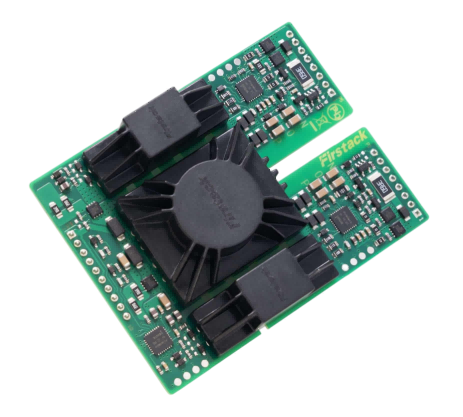
Firstack is a high-tech enterprise specializing in the research, development, and sales of power semiconductor drivers, power stacks, and testing equipment. Its 2FHC0660 gate driver core illustrates how integrated driver technology can address the requirements of high-voltage conversion systems.
Based on a digital ASIC, the 2FHC0660 supports IGBT power modules rated up to 3300V, with a specified on-state gate voltage of 15V. Its dual-channel electrical interfaces support multi-level topology, while its compact, highly integrated design provides a solution for applications where space and functional integration matter.
Key specifications include 6W output power per channel at maximum ambient temperature and a peak gate current of 60A. The product also incorporates Vce-based short-circuit protection, undervoltage lockout (UVLO), and intelligent fault management to distinguish between different fault conditions.
For engineers evaluating an IGBT gate driver for high-voltage equipment, these features provide concrete parameters for assessing compatibility with the power module and converter architecture. Final selection should also account for the complete system’s electrical interfaces, protection coordination, thermal environment, and application-specific requirements.
- Selecting the Right Technology for Long-Term Performance
Choosing a switching device requires more than comparing headline voltage ratings or semiconductor prices. Engineers should assess expected load profiles, switching frequency, thermal limits, efficiency targets, fault conditions, and service requirements. They should also compare IGBTs with SiC MOSFETs under equivalent system-level conditions rather than assuming either technology is universally superior.
The gate-drive subsystem deserves the same attention as the power module. Adequate drive capability, stable supply conditions, suitable protection, and reliable fault signaling all contribute to dependable operation. Validating these elements through simulation, laboratory testing, and system-level evaluation can reveal design issues before equipment reaches production.
Building Dependable High-Power Conversion Systems
IGBT technology remains important because it offers a mature combination of voltage capability, current handling, and established engineering practice. Its continued relevance depends on matching device characteristics to application demands and implementing sound thermal, control, and protection strategies.
Driver solutions such as Firstack‘s 2FHC0660 demonstrate the role of integrated gate-drive technology in high-voltage and multi-level converter designs. By evaluating the semiconductor and its supporting circuitry as one system, equipment manufacturers can make better-informed decisions about efficiency, reliability, and long-term operating performance.
