
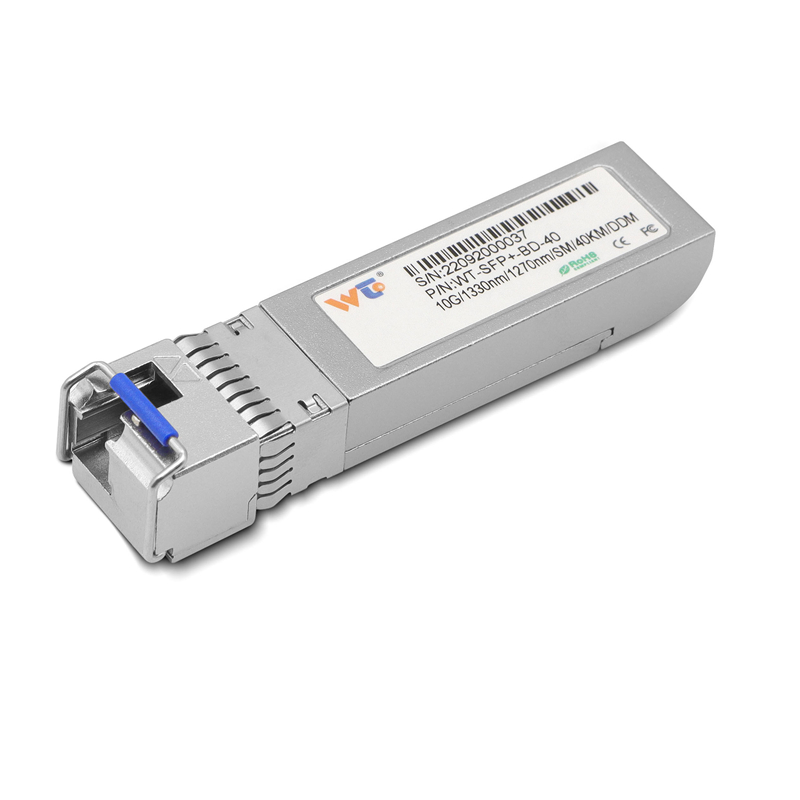
Modern enterprise communications rely heavily on modular electro-optical interfaces to maintain steady data flow across campus networks and server clusters. Operating as a compact electro-optical conversion interface, a 10G SFP+ transceiver converts high-speed electrical signals from networking switches into light pulses traveling across optical fiber cables. By utilizing an enhanced Small Form-factor Pluggable architecture, these hot-swappable components double port density compared to legacy form factors without altering base hardware designs.
Modular flexibility enables system integrators to scale bandwidth according to specific network demands. Rather than replacing physical switch chassis or mainboards, network administrators substitute pluggable modules to update transmission rates across individual switch ports. This modular design lowers infrastructure costs and simplifies routine maintenance across enterprise routing nodes.
Core Hardware Components and Diagnostic Functions
Inside a high-speed optical module, specialized electrical and optical sub-assemblies work together to process high-frequency signals. The Transmitter Optical Sub-Assembly (TOSA) employs laser diodes to convert electrical data signals into collimated optical beams for transmission. At the receive side, the Receiver Optical Sub-Assembly (ROSA) leverages high-sensitivity photodiodes to capture incident optical pulses and reconstruct original digital electrical signals.
Beyond electro-optical conversion, internal printed circuit board assemblies integrate microcontrollers that execute real-time telemetry routines. Digital Diagnostic Monitoring standards allow host equipment to monitor physical parameters, including operating temperature, laser bias current, and optical power output. Network management tools use this diagnostic telemetry to identify link degradation and mitigate hardware issues prior to network disruptions.
Short-Reach Transmission Protocols for Server Environments
Data center cabinets and server racks frequently depend on short-distance multimode connections to handle high-density patch demands. Short Reach variants operate over 850 nm optical wavelengths, utilizing multimode fiber cables to carry data up to 300 meters. These short-range optics consume low electrical power while providing steady signal integrity across short-haul server interconnects.
Direct attach copper cables and active optical assemblies offer additional options for short-distance inter-rack patching. Passive copper variants serve links within a single rack cabinet, while active optical designs provide lightweight alternatives across adjacent equipment racks. Selecting appropriate short-reach optics helps balance power consumption and thermal dissipation within dense server racks.
Long-Distance Single-Mode Optics Across Extended Networks
Connecting geographically separated facility buildings or municipal network nodes demands optical modules engineered for single-mode fiber links. Long Reach optical interfaces utilize 1310 nm lasers to maintain stable signal transmission over distances up to 10 kilometers. Extended Reach and Zero Dispersion Reach options operate at 1550 nm wavelengths to achieve transmission spans reaching 40 kilometers and 80 kilometers respectively.
Deploying long-distance optics requires accurate calculations of optical power budgets and fiber attenuation properties. Chromatic dispersion along lengthy glass fibers can broaden light pulses and cause bit error rates to rise if uncorrected. Utilizing precision laser sources assists network engineers in preserving required optical signal quality across extended fiber routes.
Single-Strand Bidirectional Media Conversion Technology
Constrained fiber conduit infrastructure often presents physical limits for network expansion in established facility environments. Bidirectional optical modules resolve single-fiber bottlenecks by simultaneously transmitting and receiving light signals on a single strand of optical fiber. By separating upstream and downstream data onto distinct optical wavelengths, these modules double single-fiber throughput without requiring extra physical cabling.
Integrated wavelength division filters isolate incoming and outgoing light channels inside single-strand optical modules. Service providers and municipal networks utilize bidirectional optics to expand bandwidth over leased dark fiber lines. Implementing single-strand transceiver technology reduces overall cabling costs while accelerating capacity upgrades across municipal utility networks.
Thermal Dissipation and Environmental Resilience
Operating conditions in unconditioned environments present severe physical stresses for networking hardware. Commercial-grade transceiver modules operate within standard indoor thermal boundaries ranging from zero to seventy degrees Celsius. Conversely, industrial-grade variants are engineered with wide thermal tolerances operating between minus forty and eighty-five degrees Celsius to withstand outdoor cabinet installations.
Thermal management inside dense network switches remains critical for preventing laser degradation and wavelength drift. Metallic module housings incorporate heat dissipation surfaces that draw thermal energy away from sensitive optoelectronic components. Rugged structural designs also protect internal circuit solder points against ongoing mechanical vibration and electromagnetic noise in industrial plants.
Compliance Standards and Multi-Source Agreements
Standardization across multi-vendor networking environments relies on Multi-Source Agreements defined by industry groups. Multi-Source Agreements establish standardized mechanical dimensions, electrical pin arrangements, and optical specifications across pluggable module product lines. Adherence to open standards allows network operators to deploy modules from diverse manufacturers without physical mismatch or signaling errors.
Embedded EEPROM chips contain operational firmware that communicates with host switch operating systems during port initialization. System software checks these microcode parameters to verify module compatibility and apply correct port driver configurations. Sourcing optics designed to open standards, such as WINTOP hardware, supports cross-platform compatibility across enterprise switching ecosystems.
Link Budget Evaluation and System Planning
Designing a stable optical network requires evaluating data rates, physical distances, fiber types, and link budget limits. Integrating a 10G SFP+ optic into existing switch backbones gives network designers flexibility to address current bandwidth demands while supporting future growth. Comparing transmitter output power against receiver sensitivity confirms total optical loss stays within acceptable operational margins.
System integrators also evaluate vendor quality control procedures and testing standards before deploying hardware in production networks. Thorough testing routines reduce long-term operational risk and minimize unexpected downtime. Tested options like the WINTOP WT-SFP+-LR transceiver module provide stable optical performance across multi-site enterprise architectures.
Best Practices for Optical Port Handling and Inspection
Proper handling during physical installation protects sensitive optical interfaces from dust contamination and mechanical damage. Microscopic particles on fiber end-faces cause light attenuation, signal reflection, and permanent physical scratching. Technicians inspect optical connectors using inspection microscopes and clean optical surfaces using specialized lint-free cleaning instruments prior to insertion.
Continuous monitoring of DDM telemetry during daily operations gives network administrators visibility into real-time port conditions. Tracking shifts in optical power levels and thermal conditions allows engineering teams to detect potential component failure early. Consistent cleaning practices combined with proactive telemetry tracking help maintain long-term network uptime across critical enterprise links.
Conclusion
Evaluating optical transmission distances, thermal parameters, wavelength options, and industry standards is essential for building resilient data networks. Deploying modular transceiver hardware enables organizations to achieve peak bandwidth efficiency while adapting to shifting network requirements over time.
Shenzhen Wintop Optical Technology Co., Ltd. brings 21 years of experience as a national high-tech enterprise dedicated to optical communication innovation and manufacturing. With over 60 core patents, WINTOP supplies industrial switches, PoE hardware, and 10G SFP+ transceiver options, including the WT-SFP+-SR model, to partners in more than 40 countries. Reach out to technical specialists today to discuss high-density optical hardware solutions for upcoming network infrastructure projects.
