
An inverter used in a commercial site does not face exactly the same operating demands as one installed on an island, at a remote facility, or inside a weak-grid system. The connected loads may differ in size and behavior, renewable generation may vary, and the external grid may range from stable to unavailable.
That variation explains why adaptability matters in an energy storage inverter. Microgrid solutions that serve more than one application require the inverter to fit different power levels, operating modes, environmental conditions, and coordination requirements without turning every project into a completely different electrical architecture.
Adaptability Starts With the Electrical Role
The first question is not simply how much power an energy storage inverter can convert, but what electrical role it must perform. In a conventional grid-connected installation, the utility normally provides the voltage and frequency reference, while the inverter follows that reference and manages battery power.
In off-grid or weak-grid conditions, the local system may need an inverter capable of establishing or supporting those electrical conditions itself. An adaptable microgrid therefore depends on conversion equipment that can participate in both grid-following and grid-forming operation as project conditions require.
The same hardware category may then support daily energy management in one installation and local grid stability in another, provided its control strategy and system interfaces are suited to both tasks.
That distinction matters because application labels can hide very different electrical requirements. Two projects described as commercial storage may have different expectations for islanding, backup duration, generator coordination, or renewable penetration.
A converter that is adequate for scheduled charging beside a strong grid may not be adequate for establishing a local voltage reference after the grid disappears. Adaptability therefore begins with matching the control role to the site rather than assuming that a common product category guarantees interchangeable behavior.
Power Range, Loads, and Dynamic Response
Different applications place very different demands on the storage converter. A commercial building may have a relatively predictable daily load curve, while an industrial or remote microgrid can experience abrupt motor starts, fluctuating production equipment, or step changes caused by generators and renewable sources entering or leaving service.
Adaptable microgrid solutions need enough power capability for the intended load profile and sufficiently responsive control to handle changes without excessive voltage or frequency deviation. The important issue is not a single nominal rating in isolation.
The inverter must be selected in relation to expected peak demand, charging and discharging requirements, transient behavior, and the way other sources share power during normal and abnormal conditions. Electrical adaptability also includes the quality of the network around the equipment.
An energy storage inverter that performs well beside a strong utility connection may face more difficult control conditions where grid impedance is high or external support is intermittent. Remote installations can add temperature, dust, access, and maintenance constraints that affect enclosure design and service planning.
For these applications, the overall architecture benefits from equipment and control systems developed with weak-grid and off-grid operation in mind rather than treating those modes as rare exceptions. Designing for all four operating states—grid-connected, weak-grid, off-grid, and hybrid—means the architecture must accommodate island systems, remote-area networks, and solar-storage-diesel configurations without assuming uniform grid support.
Environmental suitability is also tied to maintenance strategy. A remote installation may have long service intervals and limited access to specialist technicians, so protection level, thermal behavior, diagnostics, and fault handling can matter as much as nominal conversion efficiency.
In a dense commercial facility, the same priorities may shift toward footprint, acoustic limits, integration with existing switchgear, and predictable maintenance windows. Adaptability is therefore partly physical: the equipment must fit the place where it will operate, not only the electrical diagram.
System Compatibility Determines How Far Flexibility Extends
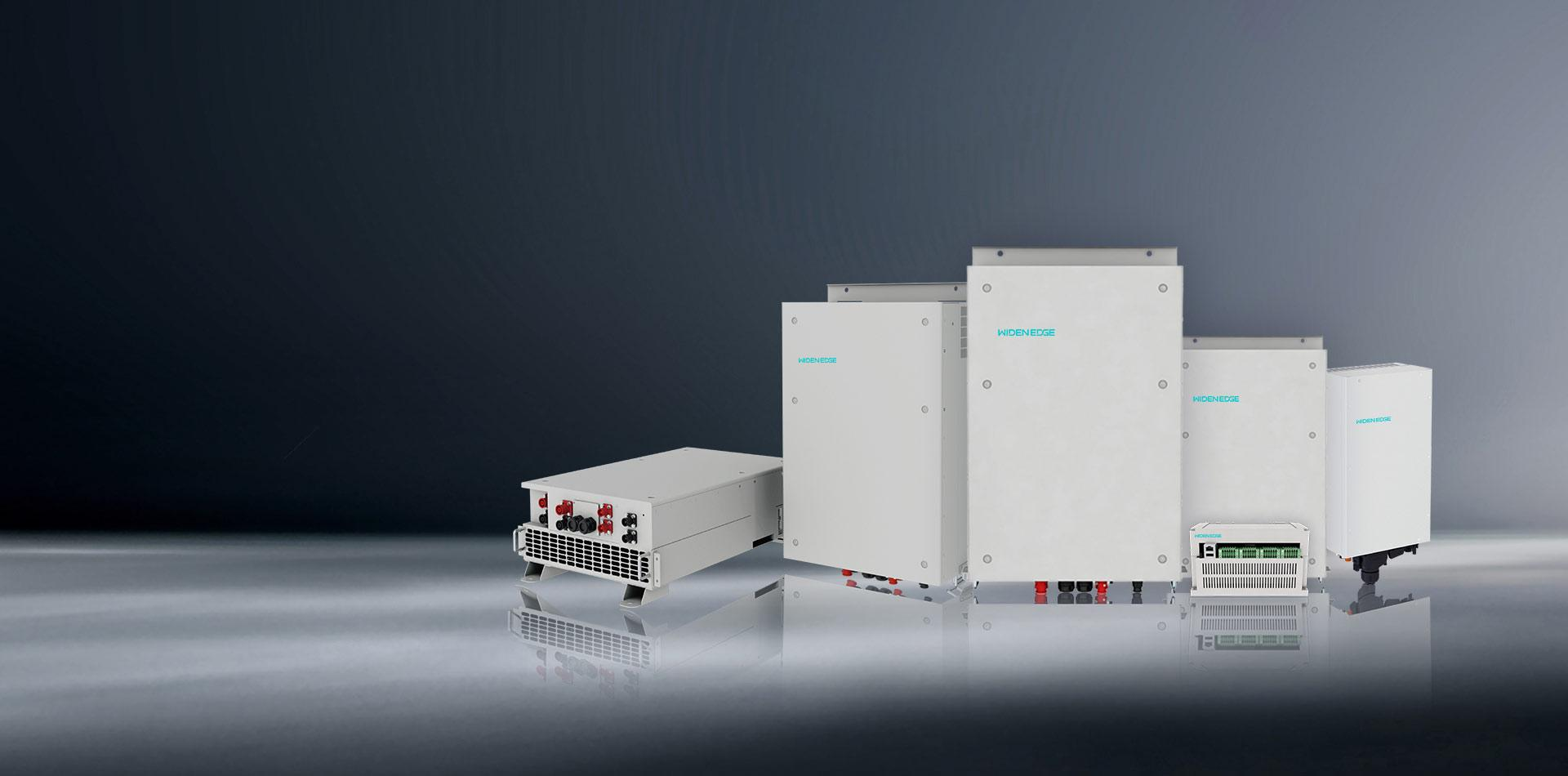
No storage converter operates alone. Its practical flexibility depends on communication and coordination with batteries, renewable generation, diesel generators, loads, and the local supervisory layer. WidenEdge addresses this compatibility at the platform level: MGC units operate alongside PV/DC and EV/DC converters under Hub local control, giving batteries, renewable sources, generators, and loads a shared coordination layer.
In this context, microgrid solutions gain flexibility because the inverter is treated as one controlled element inside a broader energy system rather than as an isolated converter. Compatibility with the control platform matters especially when a project must change operating modes, prioritize different energy sources, or maintain local power during an external grid disturbance.
Matching the Inverter to the Real Application
Adaptability is therefore a combination of electrical capability and system fit. Rated power establishes one boundary, but load response, grid-forming capability, environmental suitability, communications, and resource coordination determine how effectively an energy storage inverter can move between applications. Microgrid systems for commercial, remote, weak-grid, and off-grid sites cannot be evaluated by one operating condition alone.
WidenEdge’s platform illustrates a design direction in which conversion, renewable integration, diesel generation, storage, and local control are planned as a connected system. The closer those functions match actual site conditions, the more useful the inverter becomes across genuinely different applications.
SEO Title: What Makes an Energy Storage Inverter Adaptable to Different Microgrid Applications? | WidenEdge
Meta Description: Read our latest insights on What Makes an Energy Storage Inverter Adaptable to Different Microgrid Applications? Explore power, loads, and system compatibility.
