
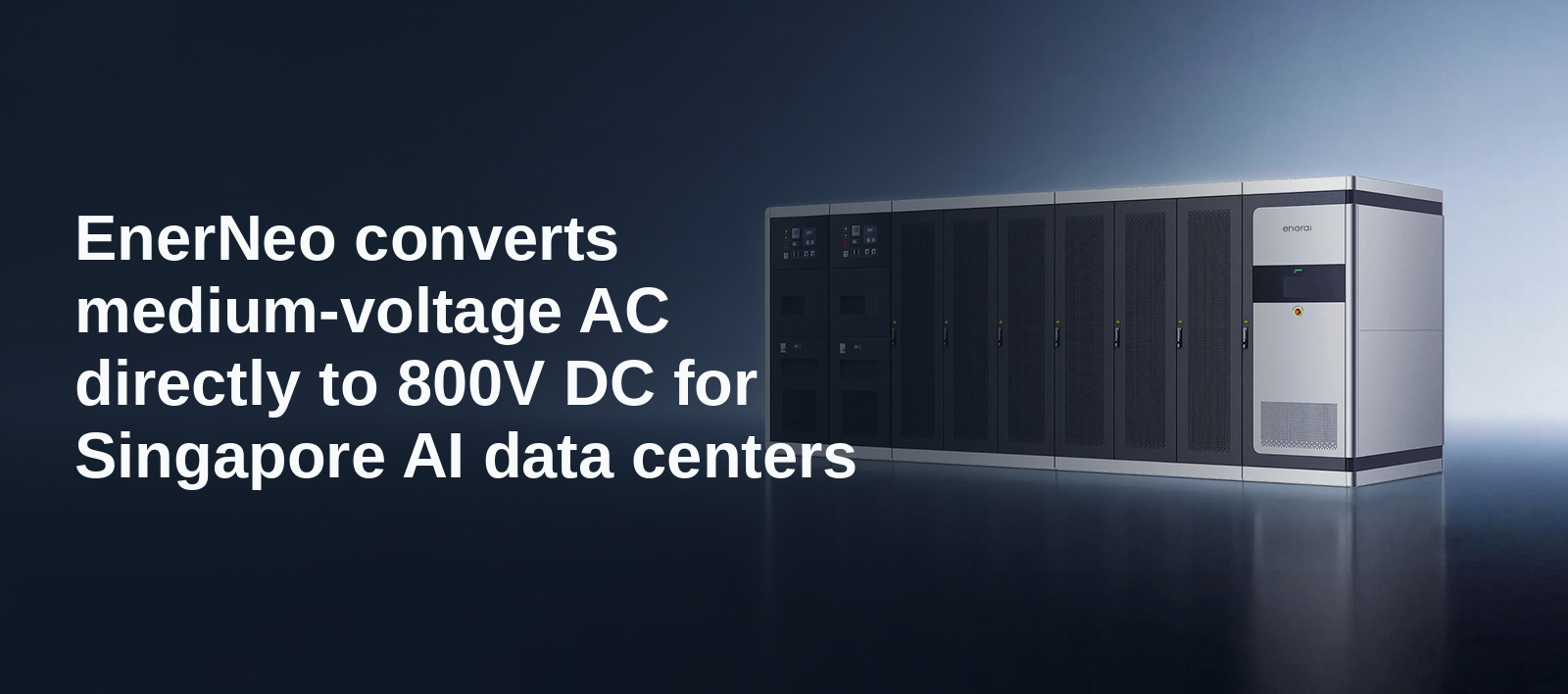
EnerNeo, the solid state transformer from EnerAI, converts medium-voltage AC directly to 800V DC. The manufacturer lists a 10–13.8 kV AC input range, 800V DC output and a 3 MW version. For a Singapore project, the selected configuration should match the site’s actual incoming voltage. Its place in a data center is at the front of the DC power path. A developer planning around this architecture can evaluate the unit where the utility supply meets facility conversion, then work through the distribution, backup and rack interfaces that follow [1].
EnerNeo links the medium-voltage utility feed to the 800V DC bus
A conventional AC design typically steps down the incoming medium voltage and carries AC farther into the facility before converting it at the computing end. NVIDIA’s published 800V DC architecture illustrates earlier conversion, with a DC distribution path serving compatible racks. EnerAI announced EnerNeo as an in-house development for that facility-level conversion stage. The product sits alongside the company’s distribution and backup offerings, which cover other parts of the electrical scope [1, 2].
Moving the conversion point changes the division of work. The utility interface still needs a defined switchgear scope. On the downstream side, the design has to account for DC protection, the backup connection and the operating limits of the rack input. The conversion point also matters when comparing losses. A bid that measures efficiency to the facility bus covers a different portion of the power path from one that measures to the internal rack bus. Using the same endpoints allows the owner to compare conversion losses across the same part of the system [2, 3].
Peak efficiency and power density define different aspects of facility design
The EnerAI solid state transformer product page lists 98.5% peak efficiency and approximately 312kW/㎡Power density. Peak efficiency is one operating point. A project energy model also needs performance at the expected initial load, at higher future loads and, where relevant, when maintenance changes how the load is distributed among units. An installed footprint similarly includes space outside the enclosure. Cable approach, cooling and clearance to remove a module all influence how much electrical-room area the project needs [1].
The input specification should reflect the utility’s nominal voltage, frequency and fault conditions. At the DC output, the design team needs the proposed operating window and interfaces to the bus, isolation equipment and racks. The Open Compute Project specification offers a common reference for those discussions. Approval of the proposed installation still rests on the model’s own documentation and the requirements of the authority and project involved [3].
The 1.5 MW, 3 MW and 4.5 MW models carry different space requirements
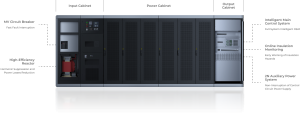
EnerAI publishes separate parameter tables for 1.5 MW, 3 MW and 4.5 MW versions of EnerNeo. The 3 MW enclosure is listed at 6,000 × 1,600 × 2,300 mm, with forced-air cooling and an IP20 enclosure rating. Those figures establish the physical equipment envelope. The room layout also has to fit cable approaches, cooling, service access and any units installed for reserve or expansion. A project comparing two conversion schemes should account for those items before assigning savings to either layout.
EnerNeo Cabinet Layout
At a phased site, the combination of units needed at opening may differ from the combination required at full buildout. A capacity schedule shows which units would be installed at each milestone, the available capacity if one unit is unavailable and the space that must remain clear for later installation. Keeping that schedule beside the room plan also makes it easier to compare the cost and space implications of installing reserve equipment on day one or adding it with a later phase.
Operating scenarios show how an SST design handles outages and maintenance
A meaningful comparison of solid state transformer packages starts with the same IT demand and redundancy requirements. A single-line drawing and equipment schedule show which components each bid includes and which ones the owner must buy separately. The useful operating cases are the ones that affect available load capacity, including loss of a source, planned maintenance and the return to normal operation. A proposal that identifies each power path and its available capacity under those conditions is easier to assess against the site’s actual loads [2, 3].
For example, a design with reserve capacity built into individual units has a different commissioning scope from one with reserves shared across several units. The facility team needs to see where the spare capacity sits, which loads can use it and whether it remains accessible when distribution equipment is also unavailable. That assessment belongs on the site drawing and the acceptance plan. The SST’s headline voltage and power ratings establish the initial fit. The operating cases establish how the proposed installation would serve the computing load [3].
EnerNeo gives Singapore developers a published option for direct conversion from medium-voltage AC to 800V DC. Its value in a specific design depends on the utility interface, how the DC distribution is protected, and the load the selected configuration must carry when part of the system is out of service. Those are the details that turn a product specification into a facility proposal. They give the developer a way to compare competing designs with different equipment boundaries but the same requirements at the utility and the racks [3].
Frequently asked questions
Can EnerNeo convert medium-voltage AC directly to 800V DC?
Yes. EnerAI lists direct conversion from 10–13.8 kV AC to 800V DC. Singapore project teams should confirm the selected configuration against the utility input and downstream distribution requirements.
How much space does the 3 MW EnerNeo cabinet take up?
EnerAI lists the 3 MW cabinet at 6,000 × 1,600 × 2,300 mm. The installed layout also needs room for cable access, cooling and service clearances.
References
[1] EnerAI, “From energy to chip, EnerAI brings full-stack AIDC power solutions to Tech Day Singapore 2026,” PR Newswire, Sept. 30, 2026. Press release.
[2] N. Srivastava and H. Petty, “Building the 800 VDC ecosystem for efficient, scalable AI factories,” NVIDIA Technical Blog, Oct. 13, 2025.
[3] Google, Microsoft, and NVIDIA, Solid State Transformer (SST) Specification: Medium Voltage to 800 VDC Power Conversion Platform, rev. 0.3.0. Open Compute Project, June 22, 2026.
